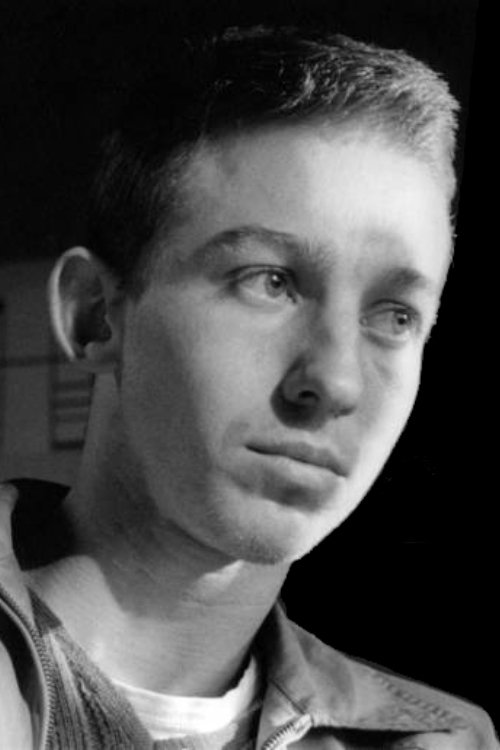
James Whitney
Directing
Biography
James Whitney was a filmmaker regarded as one of the great masters of abstract cinema. Several of his films are classics in the genre of visual music.
Known For

A visual poem of neutrons exploding and merging, with complex animation and colour effects made possible by the use of a computer. Based on complex animation techniques it shows continually flowing material in a series of pulsating motions.
Yantra
Two short fragments resulting from experiments in controlling the mechanical development of the instrument. Preserved by the Academy Film Archive in 2005.
Five Film Exercises: Film 2-3

Opens with a short canonical statement of a theme upon which the entire film is constructed. The canon is repeated in contrasting variations by means of color. A second section poses the same image in deep film space. The image unfolds itself repeatedly, leaving the receding image to continue on smaller and smaller. Preserved by the Academy Film Archive in 2005.
Five Film Exercises: Film 5

Begins with a three beat announcement drawn out in time which thereafter serves as a figure to divide the four sections. Each return of this figure is more condensed, and finally used in reverse to conclude the film. Preserved by the Academy Film Archive in 2004.
Five Film Exercises: Film 1
Animated short directed by James Whitney.
Wu ming
Dwija (1973), meaning “twice-born” or “soul” in Sanskrit. Completely solarized, its imagery is rear projected and re-photographed, to create a constant flow of hardly definable transformations of color and form.
Dwija

The entire film is divided into four consecutive chosen approaches—the fourth section devoted to a reiteration and extension of the original material. Preserved by the Academy Film Archive in 1999.
Five Film Exercises: Film 4
First film by the Whitney brothers.
24 Variations on a Theme

High Voltage is constructed from footage James Whitney contributed to Belson for use in one of his Vortex concerts.
High Voltage

A film by James Whitney.
Variations on a Circle
James Whitney’s Lapis (1966) is a classic work of abstract cinema, a 10-minute animation that took three years to create using primitive computer equipment. In this piece smaller circles oscillate in and out in an array of colors resembling a kaleidoscope while being accompanied with Indian sitar music. The patterns become hypnotic and trance inducing. This work clearly correlates the auditory and the visual and is a wonderful example of the concept of synaesthesia.
Lapis
Directed by James Whitney.