James Fotopoulos
Directing
Biography
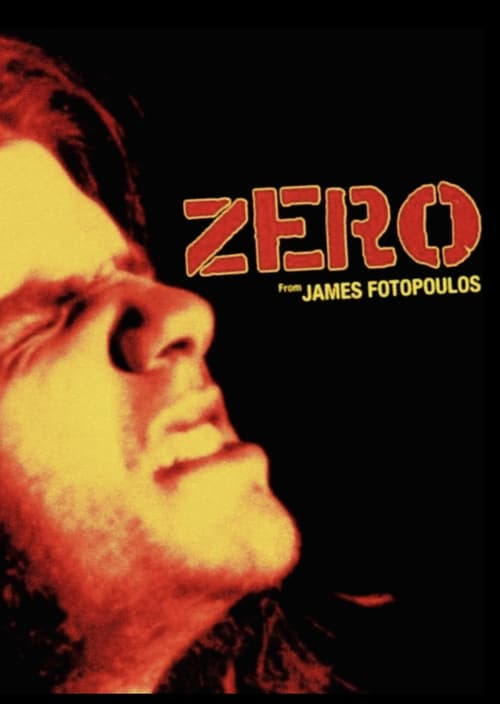
Born in Norridge, IL in 1976, James Fotopoulos is a filmmaker who began production on his first feature-length film, ZERO (1997), in 1995. In 1998, he founded Fantasma for the production of his second feature, Migrating Forms (1999), and would continue to create a number of critically acclaimed narrative feature films, such as Back Against the Wall (2000), Families (2002), The Nest (2003) and Dignity (2012). Along with his narrative productions, Fotopoulos has created a prolific body of over 200 non-narrative films, which include Christabel (2001), Esophagus (2004), The Mirror Mask (2005), The Sky Song (2007) and Alice in Wonderland (2010). These works range from feature length to a few seconds long and combine an exhaustive portfolio of visual art and performance techniques. Fotopoulos' work received a retrospective at the Anthology Film Archives; premiered at the Museum of Modern Art, MoMA PS1, Festival del Film Locarno and the Museum of Art and Design; and was screened and exhibited widely at a number of film festivals, museums, and sites, such as Rotterdam International Film Festival, Sundance Film Festival, London Film Festival, Whitney Biennial, Walker Art Center, and the Andy Warhol Museum, among many others.
Known For

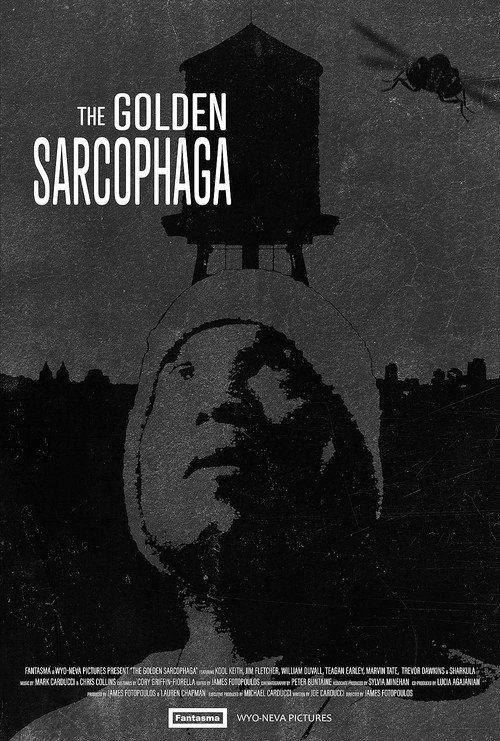
A drifter of a small storefront church's congregation stumbles across a large insect last seen before Christ and emerging en masse to render a new plague upon the world.
The Golden Sarcophaga
A man and woman embark on a sexual journey to detach mind from body. The relationship slowly grows into one of emotional domination, physical disease, abandonment and the creation of personal pornography.
Migrating Forms
Agents Mr. Rainbow and Mr. Lamb are sent to an alien planet fighting a civil war. Their mission to destroy a perpetual motion machine is interrupted by their capture. While their interrogations proceed the two men struggle to come to terms with their suffering and pending death.
Dignity

Thousands of years into the future, through the eyes of an alien life form, we see the fossilized beings of Ronald Reagan and William Casey enact their relationship as if in a crude ancient play. Through an array of text, sculptures, drawings, animations and monologues, alternate interpretations of the character’s histories and myths unfold.
Chimera
A disgruntled veteran unable to adjust back into society justifies domestic terrorism by interpreting his actions with alien invasion.
There

The story of an aspiring young Hollywood actor who, while hitchhiking to see his agent, is picked-up by a lecherous, cynical Cary Grant.
Untitled (Thanks. Get in...)

A digital poem of the flesh unfolding in near mathematical structural precision. The video’s first segment is a meditation upon the movements of a single female body. The second section focuses on the physical mechanics of a male and female couple. The human footage is augmented with superimposed abstractions, flickering lights, paintings, sound waves and sculptures.
Hymn

Christabel is an abstract interpretation of Samuel Taylor Coleridge’s unfinished Gothic poem about female possession. Adhering to the poem’s structure the film is presented in four parts – Two digital video half hour segments and then two short 16mm conclusions. The contemporary relevance of the poem’s symbols and themes is underlined using performance combined with heavy image and sound layering.
Christabel

What makes a rebel? This 78 minute documentary probes the psyche of bad-boy publisher and free speech warrior Barney Rosset, whose mid-century legal and cultural battles smashed sexual and political taboos in the United States — unleashing the counter-culture of the 1960s and introducing millions of young intellectuals to the most radical currents in literature, film, theater and politics. In his late eighties, coming to terms with his life, Barney Rosset began to obsessively sculpt an autobiographical 15′ x 22′ surreal wall mural, embedded with jewel-like vignettes crafted out of found objects, each a clue to the conflicts and obsessions that drove Barney’s lifetime rebellion against authority. A cast of artists, a neurologist, and a shaman connect the clues and piece together Barney’s life.
Barney's Wall

Short film from James Fotopoulos
Knowing and Being 1

Low-budget film about a lingerie model who keeps getting hooked up with the wrong guy.
Back Against the Wall
An adaptation of the 1886 musical “Alice in Wonderland: A Dream Play for Children” by Henry Saville Clark and Walter Slaughter, Fotopoulos’ feature length film propels the Clark/Slaughter score into the 21st century digital age. Sculptures, drawings, text, and original music are used to explore the late 19th century’s evolution of painting, literature, and theatre into early photography and moving pictures. The piece probes the interplay of art and science and in exploring these ideas certain lives and themes are touched upon – the relationship between John Ruskin and Lewis Carroll, Ruskin’s theories on drawing, Thomas Eakins’ painting and his use of photography, the burgeoning of early cinema with Eadweard Muybridge and Etienne-Jules Marey, notions of amateurism and professionalism in art and the archetype of the condemned artist. The work is presented in two acts, remaining faithful to the musical’s original construction based upon Carroll’s narratives.
Alice in Wonderland

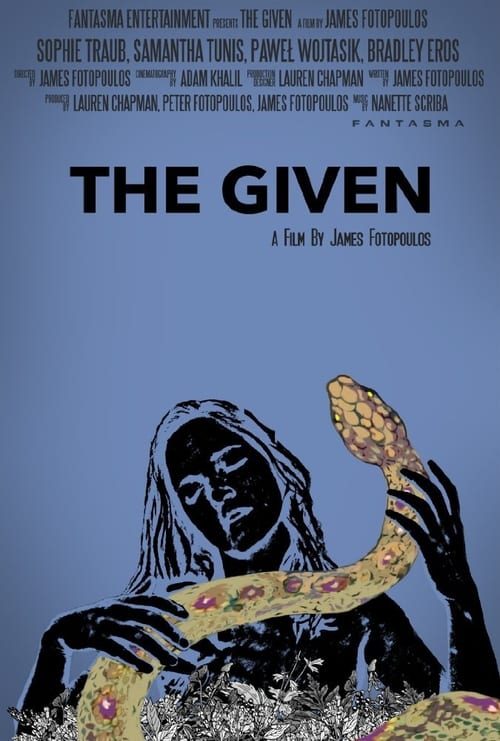
An actress living in New York performs an audition, then goes to meditation and winds up at a party of artists viewing a film. At home, she and her girlfriend explore buried memories and later nightmares trigger sleepwalking. Finally, the actress enacts a childlike performance inspired by a Frank Wedekind play.
The Given

The past, present and future. Final Obscura is a visionary film that unfolds on a space where the lines between past, present, and future dissolve into a single, phantasmic experience—an Exquisite Corpse of perception, desire, and transcendent imagination. The film submerses the viewer in a captivating, liminal dimension where the waking and dreaming worlds merge, inviting us to reflect on the nature of time, and the anamorphic emerging worlds of the anamnesis expression in seeing the sound
Final Obscura

A low-fi, grimy, VHS, edited in-camera, apocalyptic feature finalizes the cycle of videos that began with Jerusalem (2003). Two of the actresses from the first video remain but now joined with a supporting cast of public access outcasts. Using sculptures, drawings, paintings, crude animations, puppets and heavily self-conscious performance – the final piece attempts to string a through-line from the caves of Lascaux and the Gnosis to the DNA-mishap-mutants of the future.
The Pearl
Completed in 2000 (the same year as his third feature-length work, BACK AGAINST THE WALL), James Fotopoulos' THE SUN is a 16mm silent short that beguilingly cross-cuts between a lovely young woman, uncomfortably waiting, and the sun-drenched outdoors. Between these two seemingly unrelated sequences, a tension develops. Without the assistance of a soundtrack as a guide, anything imaginable could be possible. Or nothing at all. THE SUN is another remarkable selection from the Cinemad Almanac.
The Sun

Filmed in saturated colors on out-of-date film stocks with an aggressive soundtrack, the story of The Nest is told – The marriage of two young professionals unravels after an unnamed accident physically and emotional traumatizes the wife. Government agents, shadowy investigators and transgender beings appear, trying to solve the nervous-breakdown-mystery of secret alien forces that chose the couple as their target. In-camera tricks, drawings, derelict optical printing, miniatures, puppets and prosthetic makeup effects convey the dual collapse of the protagonists’ lives and the film structure as one unified entity.
The Nest

"...the simplest and most beautiful of [Fotopoulos'] early video features, which simply follows the movements of a model whose body is (re)filmed so closely that she appears as abstract swirls of colour and video grain." —Maximilian Le Cain
The River

16mm film (color)
Drowning

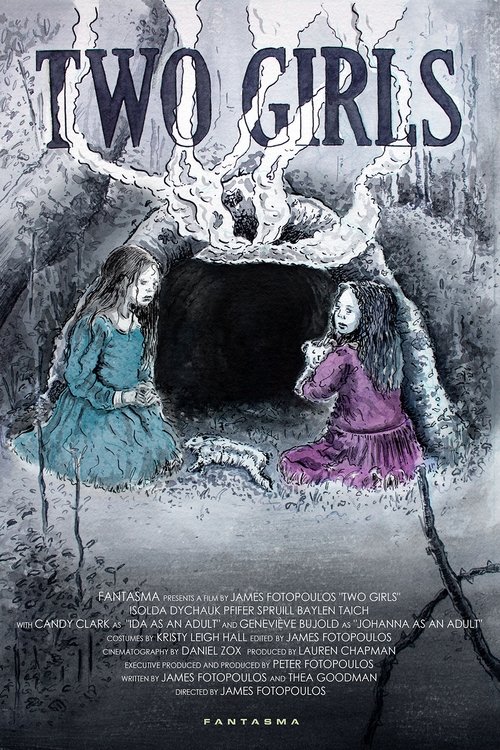
The story of young sisters in the American Midwest left alone with their increasingly unstable mother while their father is fighting in the Civil War. The film traces the girls’ naturally fraught sibling dynamic and the ways that their father’s absence ignites their imagination. When they meet a stranger in the forest they become enchanted by a world of creative work and nature, a welcome distraction from their volatile mother. Play and the dreamlike space they inhabit provides an expansive and ultimately grounding setting for the girls’ response to war.