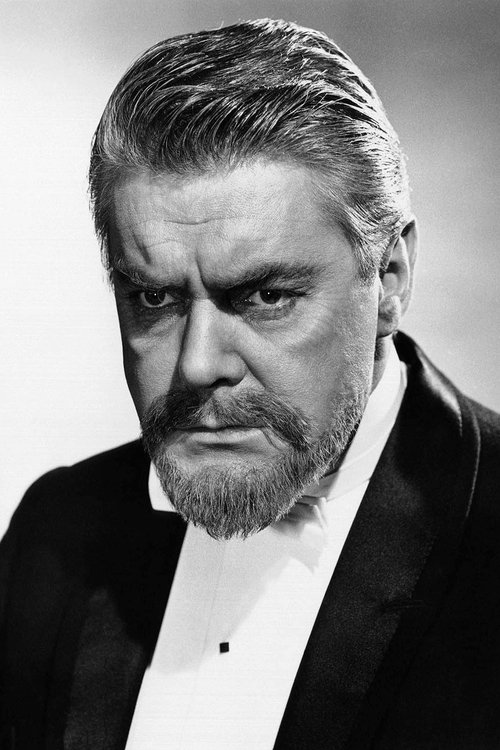
Thorley Walters
Acting
Biography
Thorley Swinstead Walters (12 May 1913 – 6 July 1991) was an English character actor. He is probably best remembered for his comedy film roles such as in Two-Way Stretch and Carlton-Browne of the FO. He also appeared in the acclaimed TV drama Tinker, Tailor, Soldier, Spy. Walters played Sherlock Holmes sidekick Doctor Watson in four unrelated films: Sherlock Holmes and the Deadly Necklace (1962), The Best House in London (1969), The Adventure of Sherlock Holmes' Smarter Brother (1975), and Silver Blaze (1977). He featured in three of the St Trinian's movies, starting as an army major in Blue Murder at St Trinian's. He later appeared as Butters, assistant to Education Ministry senior civil servant Culpepper-Brown (Eric Barker) in The Pure Hell of St Trinian's and played the part of Culpepper-Brown in The Wildcats of St Trinian's. In the 1960s he also appeared in several Hammer horror films, including The Phantom of the Opera (1962), Dracula, Prince of Darkness (1966), Frankenstein Created Woman (1967) and Frankenstein Must Be Destroyed (1969). In the DVD commentary to The Man Who Haunted Himself, Roger Moore mentioned that co-star Walters lived in Dolphin Square, the prestigious apartment block in Pimlico, London in which some scenes of the film were shot. Thorley and Richard Hope-Hawkins visited the ailing Terry-Thomas in Barnes, London in 1989. Walters had starred with Terry in the Boulting Brother's film Carlton-Browne of the F.O., and was shocked at his appearance (he was ill with Parkinson's Disease). That visit resulted in the "Terry-Thomas Gala" held in the Theatre Royal, Drury Lane in the same year which raised funds to help Terry live the rest of his life in comfort. Hope-Hawkins was with Walters and actress Siobhan Redmond, when he died in a London nursing home. Actor Ian Bannen gave the main address at his funeral held at Golders Green. Description above from the Wikipedia article Thorley Walters, licensed under CC-BY-SA, full list of contributors on Wikipedia.
Known For

Play for Today is a British television anthology drama series, produced by the BBC and transmitted on BBC1 from 1970 to 1984. During the run, more than three hundred programmes, featuring original television plays, and adaptations of stage plays and novels, were transmitted. The individual episodes were between fifty and a hundred minutes in duration.
Play for Today

Crown Court is an afternoon television courtroom drama produced by Granada Television for the ITV network that ran from 1972, when the Crown Court system replaced Assize courts and Quarter sessions in the legal system of England and Wales, to 1984.
Crown Court

Roguish comedy drama following the misadventures of small-time crook Arthur Daley.
Minder

A BBC television anthology series featuring productions of classic and contemporary stage plays usually broadcast on BBC1. Each production featured a different work, often using prominent British stage actors in the leading roles. The series was transmitted from October 1965 to September 1983.
BBC Play of the Month

A British television anthology of stories, often with sinister and wryly comedic undertones, and a twist at the end. With early episodes written and presented by Roald Dahl, the series featured a plethora of big name guest stars.
Tales of the Unexpected

An anthology series of television plays which aired on BBC1 from October 1964 to May 1970. The plays were usually written for television, although adaptations from other sources also featured.
The Wednesday Play

Series of single made-for-television dramas.
Screen Two

An English aristocrat and an American millionaire come together to tackle crime.
The Persuaders!

Thriller is a British television series, originally broadcast in the UK from 1973 to 1976. It is an anthology series: each episode has a self-contained story and its own cast. As the title suggests, each story is a thriller of some variety, from tales of the supernatural to down-to-earth whodunits.
Thriller

Pulled from actual case histories and utilizing newsreel and documented narratives, the activities of spies from various countries are depicted as far back as the American Revolution and as recent as the Cold War.
Espionage

Strangers is a 1978–82 ITV police procedural created and principally written by Murray Smith, based on characters created by Kenneth Royce in his novel series and subsequent 1977–78 television adaptation The XYY Man. Don Henderson and Dennis Blanch reprise their roles, respectively, of Detective Sergeant (DS) George Bulman and Detective Constable (DC) Derek Willis. A group of police officers are brought together from across the country to the north of England. There, the fact that they're not well-known gives them the advantage to infiltrate where a more familiar local detective could not. Despite being based around a comparatively small team of detectives, a regular feature in its early years is that few episodes feature the entire team, with most using just two or three regulars in any major role.
Strangers

In Victorian London, Louisa Leyton works her way up from servant to renowned cook to proprietress of the upper-class Bentinck Hotel in Duke Street, St James's.
The Duchess of Duke Street

A series of plays specially written for television.
The Play on One

The World of Hammer is a thirteen-part British documentary series created and written by Robert and Ashley Sidaway for Channel 4. Initially broadcast from 12 August to 4 November 1994, the series is narrated by English actor and frequent Hammer collaborator Oliver Reed.
The World of Hammer

Orson Welles’ Great Mysteries is a British television anthology series produced by Anglia Television for the ITV network and broadcast between 1973 and 1974. The series presents standalone adaptations of classic mystery, crime, and supernatural stories drawn from literary sources including Dickens, Conan Doyle, Wilkie Collins, Balzac, Maugham, O. Henry, and others. Each episode is framed by original introductory and closing sequences performed by Orson Welles, who serves as the series’ host and sole recurring on-screen presence. These segments, written and directed by Welles (uncredited), function as stylized narrative framing devices rather than dramatic participation in the stories themselves. The dramatic content of each episode is performed by separate casts and directors, with no continuing characters or serialized narrative, establishing the series as a unified television anthology rather than a collection of standalone films.
Orson Welles' Great Mysteries

Worzel Gummidge is a children's comedy series, produced by Southern Television for ITV, based on the books by Barbara Euphan Todd. Starting in 1979, the programme starred Jon Pertwee in the title role and ran for four series in the UK until 1981. Channel 4 reprised the show in 1987 as Worzel Gummidge Down Under, which was set in New Zealand.
Worzel Gummidge

Tinker Tailor Soldier Spy is a seven-part BBC2 spy drama written by Arthur Hopcraft, adapted from John le Carré's eponymous 1974 novel. The serial, which stars Alec Guinness, Alexander Knox, Ian Richardson, Michael Jayston, Bernard Hepton, Anthony Bate, Ian Bannen, George Sewell and Michael Aldridge, was broadcast from 10 September to 22 October 1979. George Smiley, the ageing master spy of the Cold War and once heir-apparent to Control, is brought back out of retirement to flush out a top level mole within the Circus. Smiley must travel back through his life and murky workings of the Circus to unravel the net spun by his nemesis Karla 'The Sandman' of the KGB and reveal the identity of the mole before he disappears.
Tinker Tailor Soldier Spy

Long-running anthology program sponsored by Hallmark Cards. Beginning in 1951 and continuing into 2019, the series received 80 Emmy Awards, 24 Christopher Awards, 11 Peabody Awards, 9 Golden Globes, and 4 Humanitas Prizes. Early seasons were a weekly live drama, eventually transitioning to videotaped and then filmed productions broadcast as occasional specials.
Hallmark Hall of Fame

Series based on the short French farces written by Georges Feydeau, Eugène Labiche, Marc Michel and Sacha Guitry. All of them include mistaken identities and impeccable timing.
Ooh La La!

Victorian England, the late 1800s: Detective Sergeant Daniel Cribb of the newly formed Criminal Investigation Department (CID) is determined to remove crime from the streets of London using the latest detection methods.