Christian Marclay
Directing
Known For
A magazine show about culture and trends and how they can shape society in unexpected ways.
Club social
Money (1985) is an historical document of the early days of "language poetry" and the downtown improvised music scene. A manic collage film from the mid-80s when it still seemed that Reaganism of the soul could be defeated. Filmed primarily on the streets of Manhattan for the ambient sounds and movements and occasional pedestrian interaction to create a rich tapestry of swirling colors and juxtaposed architectural spaces in deep focus and present the intense urban overflowing energy that is experience living here. Money is thematically centered around a discussion of economic problems facing avant-garde artists. Discussion, however, is fragmented into words and phrases and reassembled into writing. Musical and movement phrases are woven through this conversation to create an almost operatic composition. Give me money!
Money

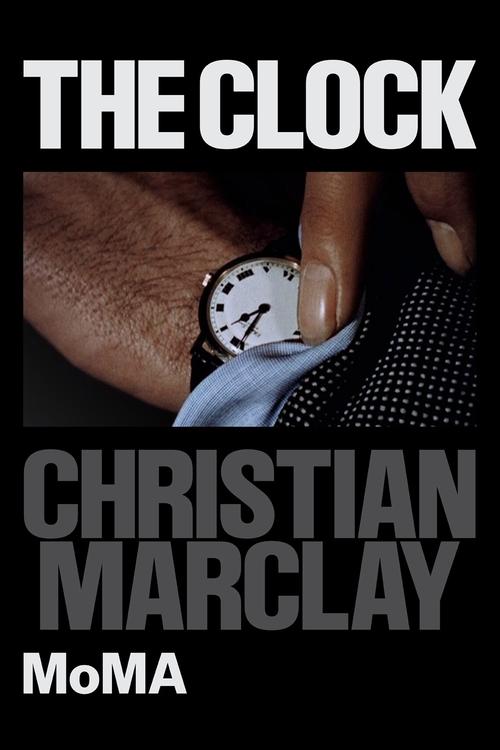
A 24-hour compendium of time-themed film clips, all synched to the time that appears on the clocks and watches within.
The Clock

The condensed filmic work of Abigail Child, borrowing strategies from found footage, Appropriation Art, Language Poetry and experimental music, stands a a landmark in the experimental cinema of the 1980's. The processing of interruption and fragmentation inform the series IS THIS WHAT YOU WERE BORN FOR?, reactivating the stakes of montage applied in different artistic practices.
Perils

For ten years, Christian Marclay collected film excerpts featuring a door opening or closing. He edited these sequences so that we see the actors going through the door to enter another space. Going through the door marks the edit point, thus the passage from one film to another and from one soundscape to another. Both audio and visual, this editing suggests a labyrinthine wandering, a mental architecture in which the characters get lost and find themselves again.
Doors
Fire, 2020, is a video animation made from paper cutouts from comic book illustrations of fire. More than 1,500 photographs shown in rapid succession suggest a flip book, creating the illusion of a flickering fire. This animated collage transforms the representations of all manner of war, catastrophe, explosion, and arson into abstracted yellows, oranges, and reds.
Fire

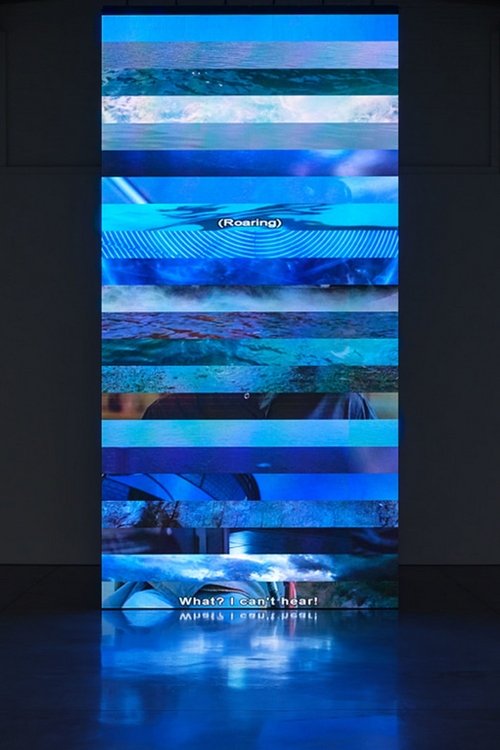
"Subtitled" is an exquisite corpse of fleeting slivers, with fragments of dialogue and closed captions flitting between glimpses of body parts, car chases, sea storms, burning buildings and an overflow of other images.
Subtitled
Gestures captures Christian Marclay's hand scratching, crossing out, and counteracting the speed of rotation of records placed on turntables. His gestures alter the analog nature of the recording and transform the vinyls into real musical instruments. The black vinyls are cut, glued, "prepared" in the sense that John Cage's pianos were, and compose a multicolored patchwork, the backdrop of this visual and sound quartet.
Gestures
Cleverly conceived and artfully edited, Christian Marclay's 7 1/2-minute video, Telephones, comprises a succession of brief film clips that creates a humorous narrative of its own in which the characters, in progression, dial, hear the phone ring, pick it up, converse, react, say goodbye and hang up. In doing so, they express a multitude of emotions--surprise, desire, anger, disbelief, excitement, boredom--ultimately leaving the impression that they are all part of one big conversation.
Telephones

For this video shot in Texas, Christian Marclay connected an electric guitar to an amplifier and dragged it behind a pick-up truck. The resulting cacophonic sound evokes noise music and the destruction of instruments at rock concerts and in Fluxus performances. The work refers more precisely to a racist murder committed in 1998 not far from the film location - James Byrd Jr. an African American, was dragged by a truck for several kilometers.
Guitar Drag
Lids and Straws animates 60 photographs of discarded plastic straws to mimic the passing hand of a clock, one second for each image. Christian Marclay took the photographs on his daily walks around London with the idea to control how single-use plastics provide mere seconds of enjoyment yet take an eternity to biodegrade.
Lids and Straws

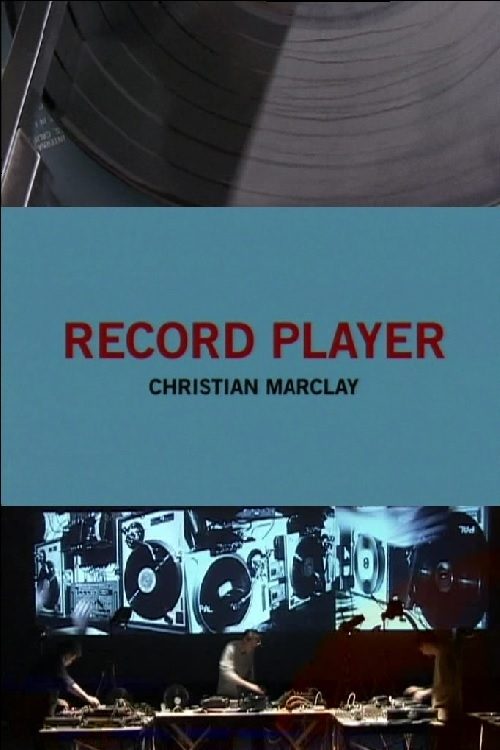
Christian demonstrates some techniques and preparations and meditates on the turntable, improvisation, and the difference between the sonic and the visual arts.
Record Player: Christian Marclay

Video Quartet brings together more than 700 film clips linked by their focus on music or sound. The work consists of four synchronised videos which are projected onto four contiguous screens.
Video Quartet
A group of assistants “play” vinyl records by hand, scratching, rubbing, breaking and finally crushing them with their feet.
Record Players
"All Together" is part of an ensemble of five works made on the occasion of a collaboration with Snapchat, the photo and video sharing application. A team of engineers from Snap inc. developed algorithms that enabled Christian Marclay to filter and classify millions of videos according to their sound characteristics. The artist thus sequenced more than 400 snaps in order to create a composition based on these everyday, often commonplace, sounds and images. It is played in a loop on ten mobile phones. This montage of hundreds of video excerpts that together produce a music is reminiscent of the work "Video Quartet" (2002), which mixes sequences from Hollywood films.
All Together

48 War Movies (2019) is a single-channel video that collapses conflicts from the Civil War to Iraq into a horrifying aggregate spectacle of war. Dramatizations are collaged into almost indistinguishable narratives and presented through concentric rectangles, like a flickering conveyor belt of popular cultural content. The forty-eight war films play simultaneously and continuously, and the accompanying soundtrack generates an indecipherable cacophony of wartime sounds.
48 War Movies

With MADE TO BE DESTROYED, Christian Marclay edits together a multitude of film clips in which artworks are destroyed. The minutia of the preliminary research and ensuing editing highlights a series of narrative and cultural patterns whereby art is the victim of violence. Whether sprayed (Batman, 1989), burnt (Equilibrium, 2002) or smashed (Le sang d’un poète, 1932 The Naked Gun, 1988), artworks are destroyed in moments that express rage against the self and others, the pain of loss, rebellion against a state or political power, or simply the perfect foil for a slapstick mishap.
Made to Be Destroyed
"Surround Sounds" is a silent video installation in which animated onomatopoeia are projected onto four walls. Christian Marclay cut out the words from comic strips and animated them so that they evoke their acoustic properties. "Whizz" runs across walls, "beep" flashes insistently, "thumps" falls systematically to the floor. Although silent, the work immerses us in a mental musical composition, a symphony of illustrated noises. Spectators hear with their eyes and develop a personal sound narrative linked memory and their everyday experience of the sounds that surround them.
Surround Sounds
In this perfomance Christian Marclay straps a turntable with the Jimi Hendrix album Are You Experienced onto his body, spinning the record. The artist channels the legendary rock guitarist by recreating Hendrix's body movements in the way he plays the LP, also creating moments of audio feedback the way Hendrix often did with his electric guitar.
Ghost (I Don't Live Today)
In this conceptual video-art piece, Michelangelo Antonioni's Blow-Up (1966) is screened with the soundtrack from Brian De Palma's Blow Out (1981).