Eugène Ionesco
Writing
Biography
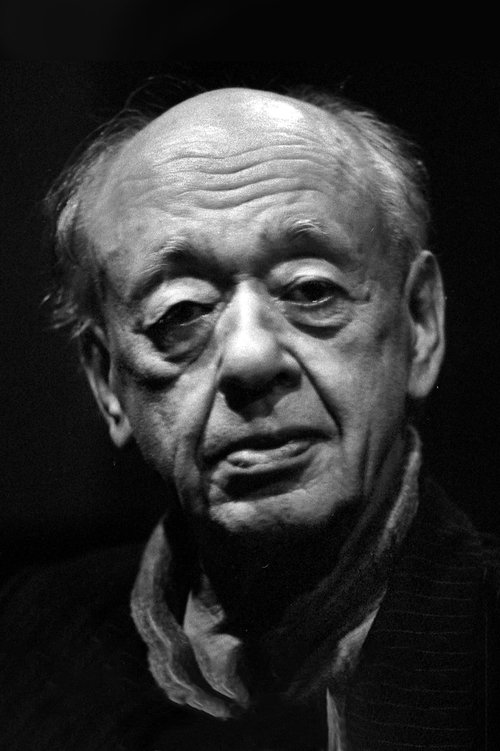
Eugène Ionesco (born Eugen Ionescu, 26 November 1909 – 28 March 1994) was a Romanian-French playwright who wrote mostly in French, and was one of the foremost figures of the French avant-garde theatre in the 20th century. Ionesco instigated a revolution in ideas and techniques of drama, beginning with his "anti play", The Bald Soprano which contributed to the beginnings of what is known as the Theatre of the Absurd, which includes a number of plays that, following the ideas of the philosopher Albert Camus, explore concepts of absurdism. He was made a member of the Académie française in 1970, and was awarded the 1970 Austrian State Prize for European Literature, and the 1973 Jerusalem Prize. Ionesco was born in Slatina, Romania, to a Romanian father belonging to the Orthodox Christian church and a mother of French and Romanian heritage, whose faith was Protestant (the faith into which her father was born and to which her originally Greek Orthodox Christian mother had converted). Eugène was baptized into the Orthodox Christian faith. Many sources cite his birthdate as 1912, this error being due to vanity on the part of Ionesco himself, who wanted the year of his birth to coincide with that of when his idol, Romanian playwright Caragiale, died. He spent most of his childhood in France and, while there, had an experience he claimed affected his perception of the world more significantly than any other. As Deborah B. Gaensbauer describes in Eugène Ionesco Revisited, "Walking in summer sunshine in a white-washed provincial village under an intense blue sky, [Ionesco] was profoundly altered by the light." He was struck very suddenly with a feeling of intense luminosity, the feeling of floating off the ground and an overwhelming feeling of well-being. When he "floated" back to the ground and the "light" left him, he saw that the real world in comparison was full of decay, corruption and meaningless repetitive action. This also coincided with the revelation that death takes everyone in the end. Much of his later work, reflecting this new perception, demonstrates a disgust for the tangible world, a distrust of communication, and the subtle sense that a better world lies just beyond our reach. Echoes of this experience can also be seen in references and themes in many of his important works: characters pining for an unattainable "city of lights" (The Killer, The Chairs) or perceiving a world beyond (A Stroll in the Air); characters granted the ability to fly (A Stroll in the Air, Amédée, Victims of Duty); the banality of the world which often leads to depression (the Bérenger character); ecstatic revelations of beauty within a pessimistic framework (Amédée, The Chairs, the Bérenger character); and the inevitability of death (Exit the King). He returned to Romania with his father and mother in 1925 after his parents divorced. There he attended Saint Sava National College, after which he studied French Literature at the University of Bucharest from 1928 to 1933 and qualified as a teacher of French. While there he met Emil Cioran and Mircea Eliade, and the three became lifelong friends. ... Source: Article "Eugène Ionesco" from Wikipedia in English, licensed under CC-BY-SA 3.0.
Known For

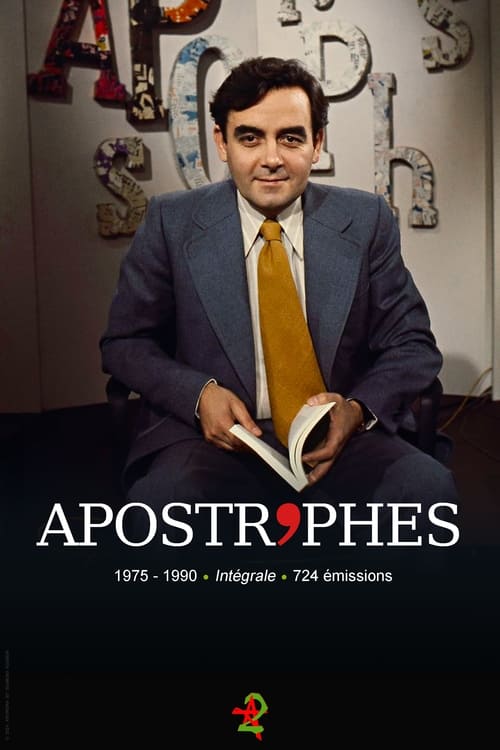
Apostrophes was a live, weekly, literary, prime-time, talk show on French television created and hosted by Bernard Pivot. It ran for fifteen years (724 episodes) from January 10, 1975, to June 22, 1990, and was one of the most watched shows on French television (around 6 million regular viewers). It was broadcast on Friday nights on the channel France 2 (which was called "Antenne 2" from 1975 to 1992). The hourlong show was devoted to books, authors and literature. The format varied between one-on-one interviews with a single author and open discussions between four or five authors.
Apostrophes

No description available.
Sacrée soirée
No description available.
Midi trente

No description available.
Cinépanorama
An anthology of single plays offering up adaptations of either of prominent stage plays or novels.
Festival

No description available.
30 millions d'amis
No description available.
Studio III - Aus Kunst und Wissenschaft

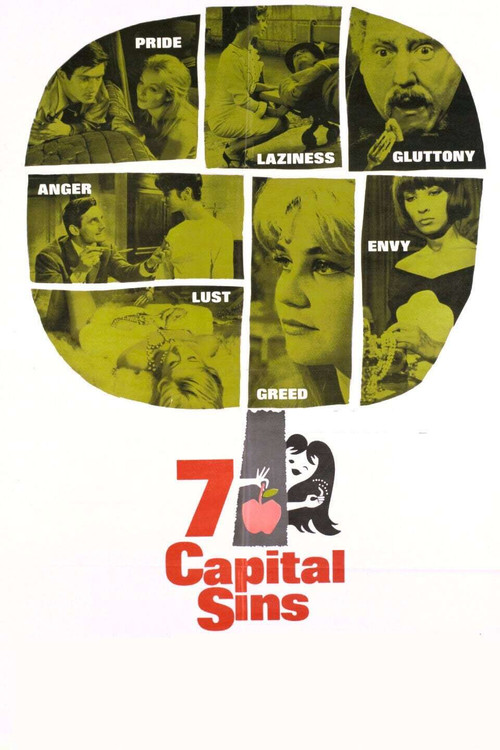
Seven directors each dramatize one of the seven deadly sins in a short film. In "Anger," a domestic argument over a fly in the Sunday soup escalates into nuclear war. In "Sloth," a movie star would rather pay someone to tie his shoe than bend over to do it himself, and he can't be bothered to accept a starlet's sexual favors. In "Gluttony," a peasant family on its way to the funeral of a relative who died from indigestion stops regularly to eat and drink en route, arriving in time to eat some more. In "Greed," a high-class prostitute refunds the price of a cadet's lottery ticket. In "Pride," an unfaithful wife finds reason to reform. And so on through lust and envy.
The Seven Deadly Sins

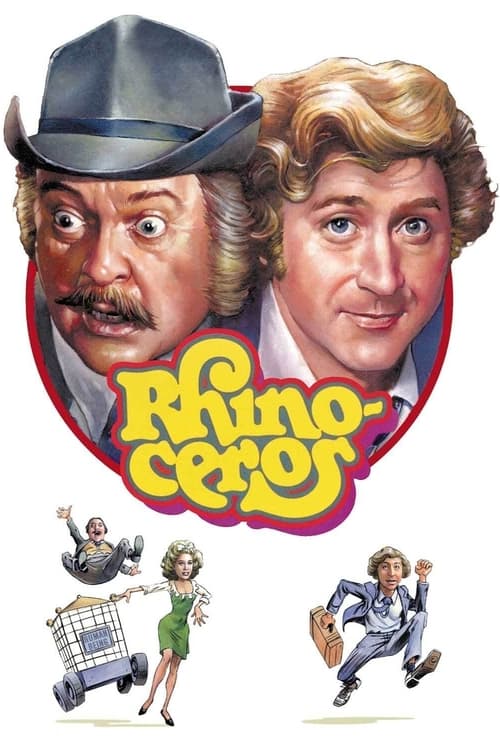
A boozing young man in love with his co-worker finds that everyone around him, even his pompous and condescending best friend, is changing into a rhinoceros.
Rhinoceros

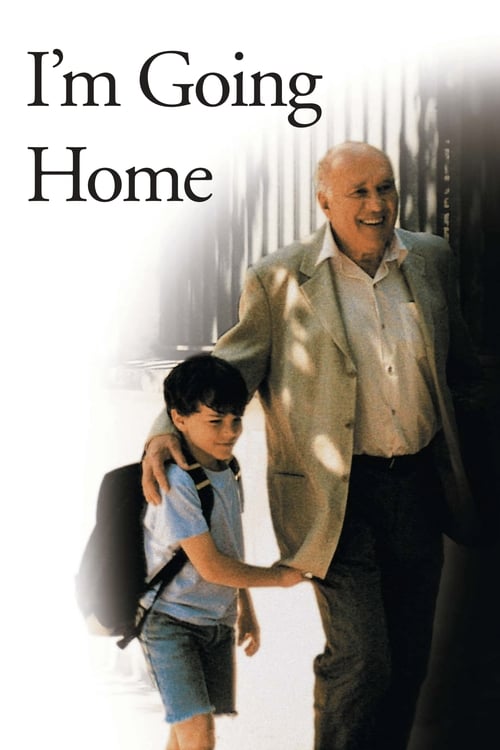
The comfortable daily routines of aging Parisian actor Gilbert Valence, 76, are suddenly shaken when he learns that his wife, daughter, and son-in-law have been killed in a car crash. Having to take care of his now-orphaned grandson, he struggles to go on with his lifelong acting career like he's used to. But the roles he is offered -- a flashy TV show and a hectic last-minute replacement in an English-language film of Joyce's Ulysses -- finally convince him that it's time to retire.
I’m Going Home

No description available.
O Gesto, a Festa, a Mensagem - Dois Mil Anos de Teatro

Anger seizes a man who finds a fly in his Sunday soup. It spreads through his neighborhood, his city, his country and soon the whole world. (Segment of "Les sept péchés capitaux")
La Colère

Monsieur Tête, an ordinary bureaucrat, rebels against the world and the ideas of the people around him. Because of his marginal behavior, his head is broken, like everyone else.
Monsieur Tête

Georges Le Roi lives odd jobs and shares his life between two girlfriends. One day, he falls in love with Sophie and records a message of love. The tape is mistakenly broadcast in the company. In the face of success, Sophie founded the company Tell me about love and spread the messages of Georges, who soon became a sex symbol.
Le Roi des cons

No description available.
Amédée ou comment s'en débarrasser
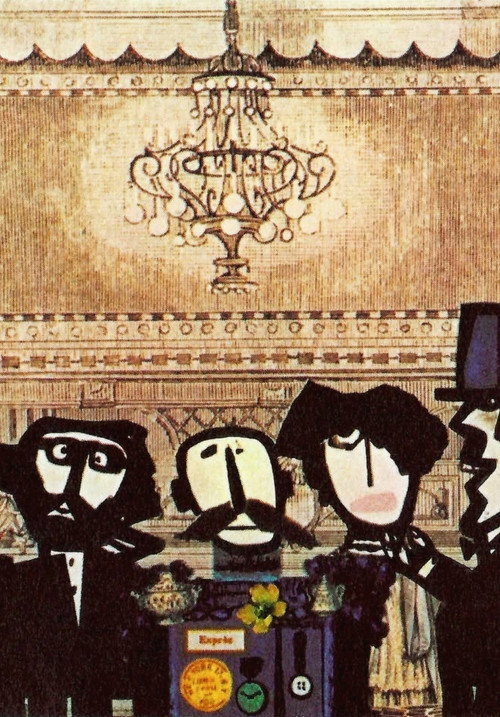
Based on Eugene Ionesco’s play, this is an animated film warning that by conforming to patterns and living en masse, people will become rhinoceroses.
Rhinoceros
A documentary about the film, I am Curious-Yellow (1967), and how it made it into the USA and changed film in USA forever by breaking the USA Obscenity Codes.
The Battle for 'I Am Curious-Yellow'

No description available.
Lucifer et moi

Free variations on a theme by Eugène Ionesco.
Regarding the Bald Singer...

A dreamlike adaptation of the legend of Ariadne and the Minotaur.