FEEL IT.STREAM
Johan van der Keuken

Johan van der Keuken

Directing

Biography

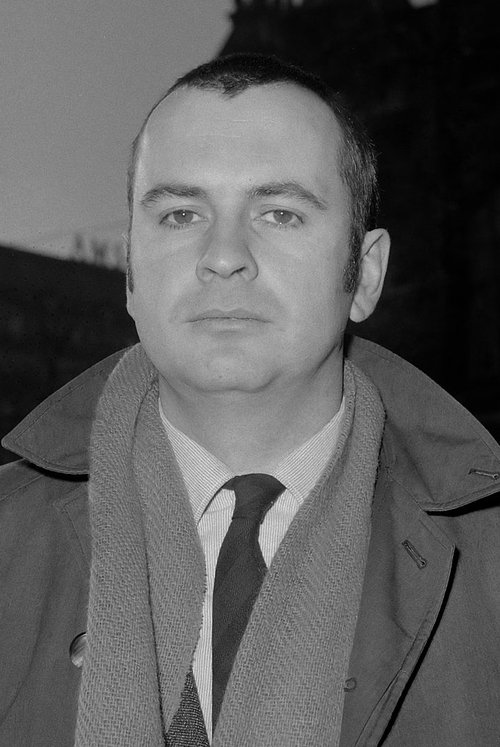
Johan van der Keuken (4 April 1938 – 7 January 2001) was a Dutch documentary filmmaker, author, and photographer. In a career that spanned 42 years, Van der Keuken produced 55 documentary films, six of which won eight awards. He also wrote nine books on photography and films, his field of interest. For all his efforts, he received seven awards for his life work, and one other for photography.
Known For

Paris at Dawn
6.8

Johan van der Keuken's first film is a uniquely beautiful portrait of Paris at dawn.

Paris at Dawn

1957
The Blind Child
7.1

With the use of montage sequences, voiced over with the observations of the children, van der Keuken was able to use artistic expression to portray the sightless children’s unique perspective of the world.

The Blind Child

1964
A Tale of the Wind
6.4

It is an autobiographical fiction starring Ivens as an old man who has spent his life trying to "tame the wind and harness the sea" by capturing them on film.

A Tale of the Wind

1989
No image
5.8

Johan van der Keuken explains, "Some fifteen filmmakers were asked to make a film series in a relay style for a very popular variety program on Dutch television: each new program was to start from the last image of the previous program, developing the story from that image. It was necessary to work according to codes of the crime thriller. I 'sabotaged' these codes, following a close-up of a pistol, inherited from my predecessor, by a series of comic observations of my cat, accompanied by a text on the need to innovate methods of expression and communication in cinema."

The Cat

1968
Filmmaker's Holiday
6.0

The film is put together as a collection of autonomous images which, once combined, make up van der Keuken's mental universe: family happiness, fragments of some of his earlier films, a homage to the saxophonist Ben Webster, two poems by the great contemporary poets Remco Campert and Lucebert, a portrait of the director's grandfather, who taught him photography at the age of twelve... 
"One of those small masterpieces one encounters by surprise..." Jean-Paul Fargier, Cahiers du Cinéma, 1975

Filmmaker's Holiday

1974
Big Ben: Ben Webster in Europe
5.5

In the late sixties, the American saxophone player and living jazz legend Ben Webster lived in Amsterdam for a year. Webster, who was born in Kansas City in 1909, was a unique personality in the world of jazz and blues. In the thirties, he played with all the great names. During his Amsterdam period, he stayed with an elderly landlady, Mrs Hardloper, with whom he appeared on a national talk show. In conversations with Van der Keuken, he muses on the past; on the fantastic experience of playing in the renowned Duke Ellington band; or on one of his best friends, who was so deft at eating with a knife and fork. Short, fragmented remarks, which Van der Keuken has edited in a loose, improvised editing style.

Big Ben: Ben Webster in Europe

1967
No image
6.3

In the person of To Sang, a Chinese-born photographer living and working in Amsterdam, JVDK has found his perfect counterpart and alter ego. To Sang's monumental, stagey portrait photos reach back toward painting, just as JVDK's carefully composed film images recall still photography. Like JDVK, To Sang works in close collaboration with his wife. As image-makers, both men gently but firmly impose their way of seeing on the world. "Although we laugh at first, in the end he is master of the situation," says JVDK about To Sang in Gieling's film.

To Sang Fotostudio

1997
De Appel-iep
N/A

As part of the celebrations for 100 years of Amsterdam’s Vondelpark in 1965, the Vondelpark was transformed into a massive sculpture garden under the direction of Stedelijk Museum director Sandberg. 25 epic artworks by well-known artists such as Pablo Picasso, Alexander Calder, Henry Moore, Shinkichi Tajiri and Jean Tinguely were placed in the park. Karel Appel was also represented, by a gigantic elm tree trunk brightly painted in Appel’s characteristic manner.

De Appel-iep

1965
Blind Child 2
6.9

Two years after making his film BLIND KIND, Van der Keuken contacted the blind boy that had impressed him most at the time.

Blind Child 2

1966
A Moment's Silence
6.8

In his very first ‘independent film’, Dutch master filmmaker Johan Van der Keuken presents an image of Amsterdam in the sixties. He set out taking just his camera, without any pre-defined concept. The result is a poetic observation of Amsterdam by a deeply committed filmmaker.

A Moment's Silence

1963
No image
N/A

Short documentary about Yrrah, the ruthless illustrator who was always giggling. First of four in a series for the VPRO.

Yrrah

1962
No image
7.0

The point of departure for this film is the 1981 composition De Tijd by Dutch composer Louis Andriessen. Van der Keuken leaves the music undisturbed as an autonomous soundtrack and has the images engage in a sort of battle with it. These images are associations, fragments of events, scenes and situations. The film is preceded by a text by Bert Schierbeek.

Time

1984
Temps/Travail
6.5

This film is a playful and experimental film object. The images of several films by Johan van der Keuken are mounted in a rhythmic and circular way to emphasize the repetition and similarity of the gestures they give to see: the daily gestures of men and women at work, throughout the world.

Temps/Travail

1999
No image
N/A

Following in the footsteps of his uncle, this film documents the last days of Johan van der Keuken.

Last Words

2002
The Eye Above the Well
7.2

A poetic depiction of life and ritual in the south Indian state of Kerala. We see how knowledge is passed down from generation to generation: within the family, through the village economy, and especially from teachers to students. Performance footage shows how song, dance, martial arts, and religion constitute the building blocks of a culture.

The Eye Above the Well

1988
No image
7.0

Part of Johan van der Keuken's North/South series, The White Castle focuses on the impact of the West on the underclass: on the concrete realities of their daily life and on the way their existence is isolated and frustrated. Interweaving images of the Spanish tourist mecca of Formentera, a community center in Columbus, Ohio, and factories in the Netherlands, the film vividly illustrates the fragmented, alienated lives that the market economy produces and chillingly portrays what van der Keuken saw as "a conveyor belt [that] runs across the world."

The White Castle

1973
The Mask
N/A

During the celebrations of the bicentenary of the French Revolution, Johan van der Keuken made a film about the revolutionary ideals of equality, liberty and fraternity. Rather than lingering on the festivities, he lingers on the crowds in the metro and on the platform. Amongst them is Philippe, a 23 year old, homeless and with no real job. More than just a comment on the ignorance and contradictions of France at the end of the 1980s, THE MASK is an exchange of views on solitude. Isn’t the question of violence in our democracies firstly that of the real price society pays for the image it would like to show?

The Mask

1989
Trying to Describe Oneself
7.4

Trying to describe oneself is a movie about representation. How it is possible, through film, to describe oneself and describe others. With the camera as mirror and third eye. At first, a collage-like combination of letter-writing, investigation and journey, something between documentary and feature film. Finally, a portrait of Boris Lehman from 1989 to 1995, part II of BABEL.

Trying to Describe Oneself

2005
Hollywood by Bike
7.0

Documentary that looks back at 35 years of Dutch cinema, with Paul Verhoeven and others.

Hollywood by Bike

1993
No image
10.0

Documentary by Jan Sebening and Daniel Sponsel.

The Last Documentary

2000