Patrick Jolley
Directing
Biography
Patrick "Paddy" Jolley (1964 - 2012) was an Irish photographer and filmmaker from County Down, Northern Ireland. At fifteen he moved with his family to the village of Dunmore East in County Waterford. In 1989 he graduated with a BA in Printmaking from the National College of Art and Design, Dublin. Following this he lived and worked in London and New York, but it was in Prague where he moved with the artist Inger Lise Hansen, that he became increasingly preoccupied with photography. In 1994, he was awarded a scholarship for the MFA photography programme at the School of Visual Arts in New York which propelled him to begin experimenting with film. He returned to Ireland in 1996, but continued to travel, mostly in Eastern Europe. In 1998 he took part in the residency programme at the Irish Museum of Modern Art, followed by a residency in New York as part of MoMA PS1’s International Studio Programme, which saw the beginning of an extended collaboration with the film-maker Reynold Reynolds. Their first short film 'Seven Days ‘Til Sunday' (1998) won him Best New Director at the Cork Film Festival, and was screened at London's Tate Modern. Their next project, 'The Drowning Room' (2000), was screened at the Sundance Film Festival, and is in several important collections including the Neuer Berliner Kunstverein (n.b.k.). The film installation 'Burn' (2002) was included in the 3rd Berlin Biennale (2004) and is part of the collection of the Museum of Modern Art, New York. Jolley left America for Berlin following the changes brought about by 9/11 but returned to New York to make one final film — 'Sugar' — with Reynolds in 2005. There was also one other collaborative film — 'Here After' —made in Dublin in 2004 with the artists Inger Lise Hansen and Rebecca Trost, which is part of the collection of the Irish Museum of Modern Art. Jolley then returned to Ireland where he made nine solo films in eight years. His film, 'The Door Ajar' (2011), a surreal visualisation of Antonin Artaud’s traumatic visit to Ireland, departed from his usual format of non-verbal shorts. It was exhibited at Dublin Contemporary 2011. Jolley died suddenly in January 2012.
Known For
Burn is a narrative collage, with people and allegorical creatures. A house burns from the inside while its occupants focus on the emotional issues of their lives. The inhabitants serve life sentences with no remission in a structure of insecurity - while impending disaster is ignored. An absent minded couple sits calmly reading as fires erupt in their clothing, books and furniture. They nonchalantly swat at the flames with a stoic inattentiveness. Burn embraces an anti-narrative structure yet intense drama is found in the work. Finally a decisive act is taken leading to the possibility of a miraculous event.
Burn
In August 1937, French dramatist and poet Antonin Artaud landed in Cobh and journeyed to Galway with the intention of returning the alleged staff of St. Patrick to its rightful owners, and, with their help, rediscovering some fundamental truths.
The Door Ajar
A young woman rents a shabby one room apartment, opening the door for visions, nightmares, memories, and revenge.
Sugar
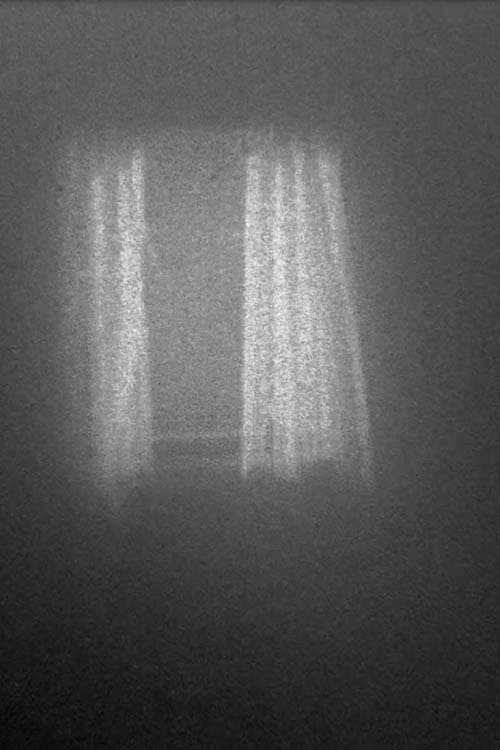
A sequence of domestic vignettes from the sunken suburbs. In the house, the stagnant atmosphere has slowly thickened to liquid. The inhabitants try to carry on as normal but beyond the borders of asphyxiation; communication is limited and expression difficult. Filmed entirely underwater in a submerged house to create an atmosphere unlike any other film.
The Drowning Room
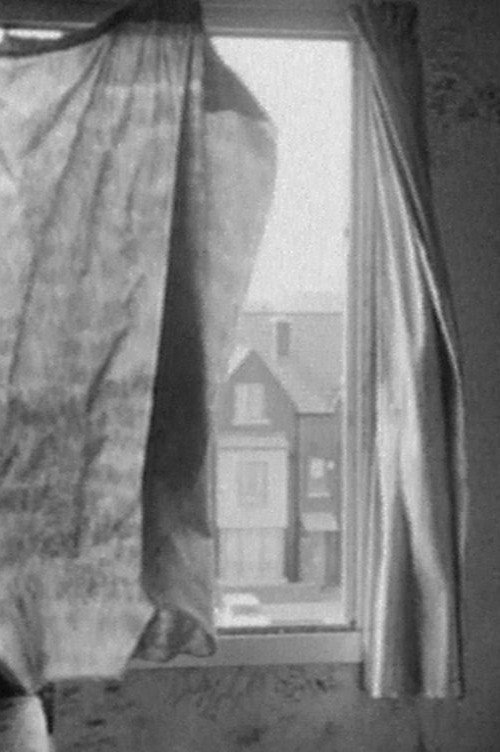
In ‘Here After’, filmed in a soon-to-be-demolished inner-city tower block on the north side of Dublin, objects disintegrate before our eyes, as though being eaten by some strange virus or invisible entity. The contents of a room disappear as the carpet beneath them is sucked into a void below. Wind haunts the empty spaces, stirring the curtains on an open window, or the wallpaper which barely clings to the damp wall. This movement is contrasted by the stillness of an undressed bed, a rectangle of light from outside creeping over its surface, pausing as if resting one last time before moving off again. The barrier between the interior and exterior is no longer intact, and nature encroaches – water dripping down walls, advancing slowly over floors, spilling dangerously from light-fittings. Light spills in too, but rather than hopeful illumination, its presence is menacing, evoking a sense of time passing too quickly, bringing premature decay.
Here After

Seven Days ‘til Sunday, the first of three Jolley/Reynolds film collaborations, is a sequence of short episodes in which headless figures fall through the architecture of New York, incinerate in their own living room, detonate on wet ground. This strange depiction of anonymous, marginalised individuals meeting their end amid relentless urbanisation provides the imagery, but beyond the particularisation of their fates ‘the narrative stands for the tragi-comedy of life itself in a remote, indifferent universe.’
Seven Days 'Til Sunday
A visual essay on the momentary dislocation of falling objects.