Acting
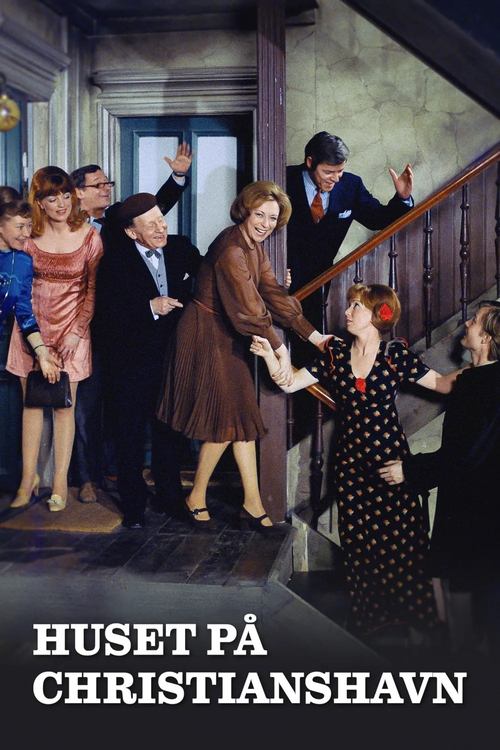
The series follows the residents of an apartment building on Copenhagen's Christianshavn, as they go about their daily lives and challenges. There is Olsen, a mover with an old fashion view of the world, Clausen who runs the local pet shop, Egon the career focused assistant, their wives who work hard to keep their spouses lives together, the young couple Tue and Rikke who recently moved in, the hard working caretaker Meyer, who never puts in to much effort, and of course Emma, the innkeeper of Rottehullet, where all the important decisions are made while running up the bar tab. The series was produced by Nordisk Film for Danmarks Radio TV station between the years 1970-77. The series' first director was Ebbe Langberg, then Erik Balling and Tom Hedegaard respectively. The series was conceived by an author team of well-known Danish authors such Leif Panduro, Benny Andersen, and Lise Nørgaard.
An uptight, confused man lives with his wife and maid next to a big tree. He suspects people live up in the tree when he keeps finding various items and trash under the tree. The government appointed street cleaner doesn't do much, except occasionally take trashy people off the street and into the garbage. He suspects the maid of stealing food and sexual perversions, and the police precinct is literally a farm with insane cops imprisoning lamps and horses.
Depiction of ordinary everyday life. The action takes place in an office, with the characters Tom, Norman, and Carl as the focal points.
No description available.
At the Copenhagen Conservatory of Music, Mogens Birk passes his organ exam with distinction. Together with his brother Steen Birk, he has supported himself during his studies by playing in the city's small taverns. Editor Jepsen from Bollerupager attends the exam, with a view to hiring a new organist for the city. At the parish council meeting, Consul Møller's daughter Kirsten, who was educated in Paris, is nominated, but Jepsen has Mogens as his candidate for the position, and he gets the job.
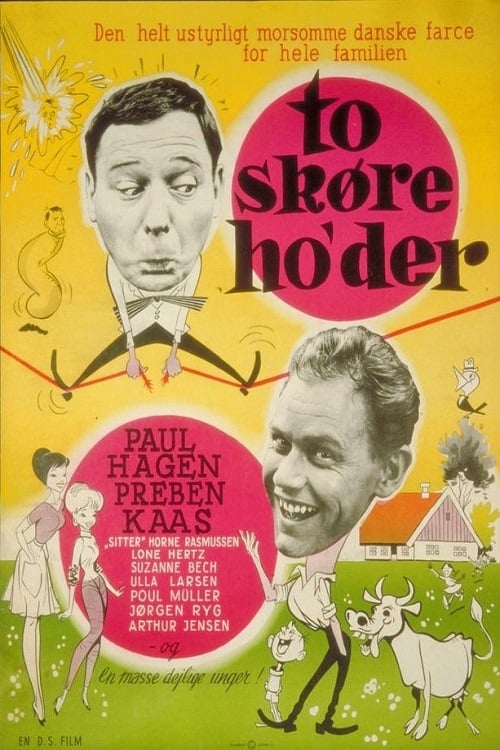
Two tough guys, Paul and Preben, are in the same hospital, both admitted for stomach ulcers. Paul because he's sick of his aunt Klara and his cute fiancée Susanne's crazy care, and Preben because he won big on the lottery and can't find the ticket. One morning, they are brutally awakened by the head nurse: they are to be taken for examination. But for some reason, panic breaks out in the hallway, Paul's bed crashes into Preben's, runs into the venerable chief physician, and the wild ride continues. Of course, the two guys are thrown out of the hospital with a bang, but they take the problems as they come and head out onto the open road.
Three out of work actors breaks into a bank through the toilet of a railroad station.
Lis Holst desperately wants to become an actress. After failing an audition at a theater, she decides to resort to other, more drastic measures. When the director and the theater's writer go to the countryside, Lis goes with them. There, she performs a masterpiece of disguise. When the truth dawns on the theater director and the writer, they decide to take advantage of Lis, as the theater's prima donna has taken up residence. Lis is promised a leading role in the next performance, but then the prima donna recovers and wants her role back.
Four young men, Henry, Toft, Tam, and Klausen, take the train to Maribo, ending up at the prison gates. All four are serving sentences for drunk driving. They are a little embarrassed, but each has a good explanation for the "accident." They are "almost innocent" and therefore entitled to make the best of their voluntary "vacation."
About the traditional celebration at Christmas. It is a safety valve, a cleansing bath that gives strength and zest for life well into the new year. "People meet" – and masks fall around the lavishly laid tables, where the director and the workers drink together. Local democracy works – and long-standing marriages falter! However, very few Christmas parties reach the same heights as the one enjoyed by the staff at Simonsens Bijouteri Fabrik.
Mogens Wieth is a songwriter who lives beyond his means. He is expecting to inherit a fortune from his Aunt Tut in Paris, who is old and filthy rich. He has been corresponding with her for many years. In reality, Aunt Tut is dead, and it is her daughter who writes the letters. A young singer who wants to ingratiate himself with the songwriter claims that he knows the aunt and that she is coming to Copenhagen. He has persuaded an older actress to play the role of Aunt Tut. Unfortunately, the aunt's charming daughter also arrives in Copenhagen at the same time, setting the stage for costly episodes and amusing complications...
The young sailor Morten returns home from his travels in the midst of the general strike of 1944, where he is confronted with the occupation. He joins a resistance group and actively participates in the struggle. There is no time for relaxation. He must always be on guard. Only with the sweet and charming young Lise can he relax a little and be himself. During a factory sabotage, the group is captured by the Germans.
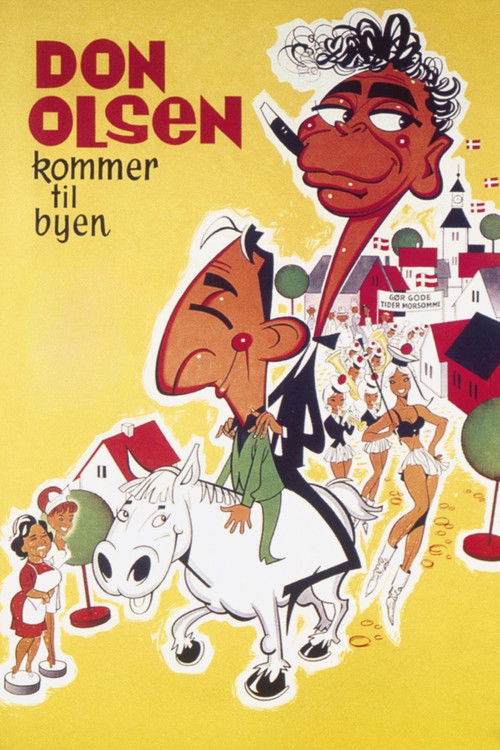
Bank director L.W. Jacobsen resides in a small provincial town. He is not particularly interested in his wife, Elsebeth, but rather in teacher and city council member Miss Mortensen. Thorsen, the town's manufacturer, is a member of the same city council group as Jacobsen. Then Don Olsen comes to town. Olsen is not interested in the upper class, but rather in people. By chance, Thorsen and Olsen meet and soon become drinking buddies. Thorsen drags the milkman's horse home to his apartment in the middle of the night. The scandal is a reality. Thorsen wants to flee, but with Olsen's help, he instead woos the townspeople and Miss Mortensen under the motto "Make good times better."
Bizarre satiric tale about an ordinary Danish man disappointed in life and the welfare system. Close to a total collapse he decides to take the easy way out. He seeks help at Doctor X, head of a suicide school that guarantees 100% efficiency.
Jan Scharf's band is playing at Grönköbing Folk Park. Pianist Jan flirts with a young female audience member. Her friend notices what is going on, so they have to flee headlong. Back home in Copenhagen, they discover that their old residence has disappeared and a new high-rise building is going up, leaving them homeless. Jan has an uncle in Nyhavn, where he plans to stay temporarily.
Nina and Frederik were the big names in international showbiz in the 1950s with their rousing calypso rhythms. That's why "Kærlighedens Melodi" (The Melody of Love) was bound to be a hit when the young, beautiful couple teamed up with the legendary, wonderful "Satchmo," Louis Armstrong, from the world of jazz. Musical interests vary widely in the affluent neighborhood of Hellerup. At the Schmidt wine merchant's, son Peter has only one interest: jazz. At the Supreme Court lawyer's house next door, Mozart is on the program. But his daughters like both jazz and Peter! Even though their fathers are suing each other, the two young people still find each other. And Louis helps when he plays "The Formula for Love."
A group of young actors, ambitious and naive, dream of their big breakthrough, criticize the theater school, want to revolutionize theater, and never compromise, but are very uncertain about the future and their own identity.
Arntsen takes things and people around him too seriously, and has therefore been awarded a disability pension. And he is not exactly clairvoyant either. But that may come, and often with female help from, for example, Vaskemutter, for whom he does the laundry, or Mette, who has her own problems and accepts him as he is – even without clothes.
Beatrice abandons her husband Peter because he is impotent in their sex life, instead she travels to paris with her lover Isac. Meanwhile Peter stays with his friend Ole where he becomes an object of erotic desire of both Ole's wife and daughter.
An unsuccessful animal impersonator wants publicity and feeds an overly eager journalist a story. The impersonator says he is going to Africa to roar like a lion, and people believe him. The front-page sensation spreads to the foreign press, and in the end, the poor liar has to take out his savings and travel to Africa to prove that the lie was true enough.